Before you get married or plan to have children, there is one simple blood test that could prevent a lifetime of suffering for your child. It costs almost nothing. It takes one day. And it could change everything.
What is Sickle Cell Disease?
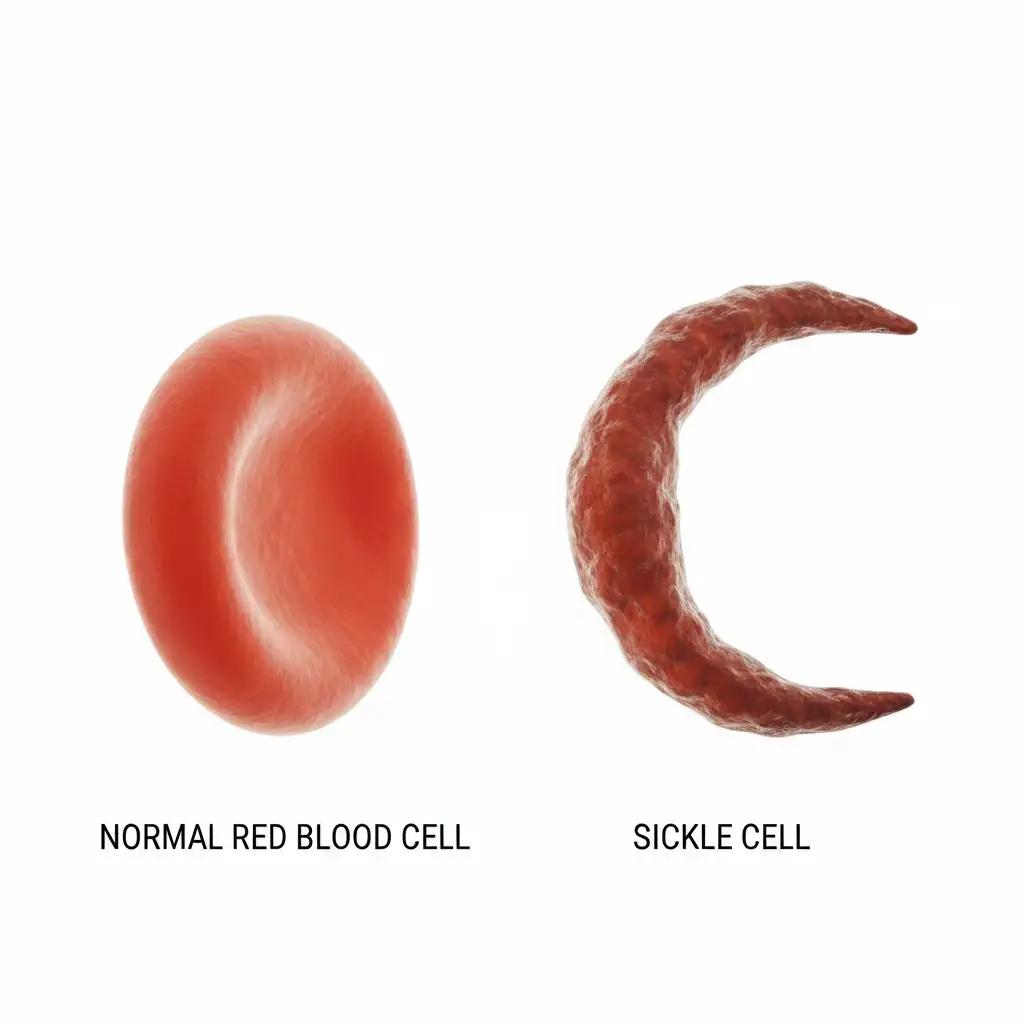
Your blood is full of red blood cells. Their job is to carry oxygen from your lungs to every part of your body. Normally, these cells are round and flexible — they can squeeze through even the smallest blood vessels without any problem.
In sickle cell disease, these cells change shape. Instead of round, they become crescent-shaped — like a sickle or the letter C. These misshapen cells are stiff, sticky, and fragile. They get stuck inside blood vessels, blocking blood flow. They also die much faster than normal cells.
The result? Severe pain, damaged organs, frequent infections, and a shortened life.
Sickle cell disease is not an infection. You cannot catch it from someone. It is inherited — meaning it is passed down from parents to children through their genes.
What is a Genotype?
Think of your genotype as your blood's genetic identity card. For hemoglobin — the protein in red blood cells that carries oxygen — you inherit one gene from your mother and one from your father.
There are two main types of hemoglobin genes that matter here:
- A — the normal gene. Produces healthy, round red blood cells.
- S — the sickle gene. Causes red blood cells to become crescent-shaped when oxygen is low.
Combine these two genes and you get your genotype.
The Four Genotypes You Need to Know
AA — Completely Normal
You have two normal genes. Your red blood cells are healthy. You do not have sickle cell disease and you cannot pass the sickle gene to your children.
AS — Carrier (Sickle Cell Trait)
You have one normal gene and one sickle gene. You are a carrier. In everyday life you are completely healthy — you will not get sickle cell disease. However, you carry the sickle gene and can pass it to your children. This is the genotype that causes the most problems in marriages because many AS people do not know they are carriers.
SS — Sickle Cell Disease
You have two sickle genes. This is the full disease. You will experience painful crises, frequent hospital admissions, organ damage over time, and a life expectancy that is significantly shorter than average. This is the genotype everyone is trying to prevent in their children.
AC — Hemoglobin C Carrier
You carry one normal gene and one hemoglobin C gene — a different variant. You are healthy but you can pass the C gene to your children. If your partner has the S gene, your children could be born with SC disease.
What Happens When Two People Have Children Together?
Every child inherits one gene from each parent. So the genes you and your partner carry will determine what genotype your child is born with — and you have no control over which combination they receive.
This is pure genetics. It is not about love, prayer, or luck. It is mathematics.
Safe Combinations
These pairings carry no risk of producing a child with SS disease:
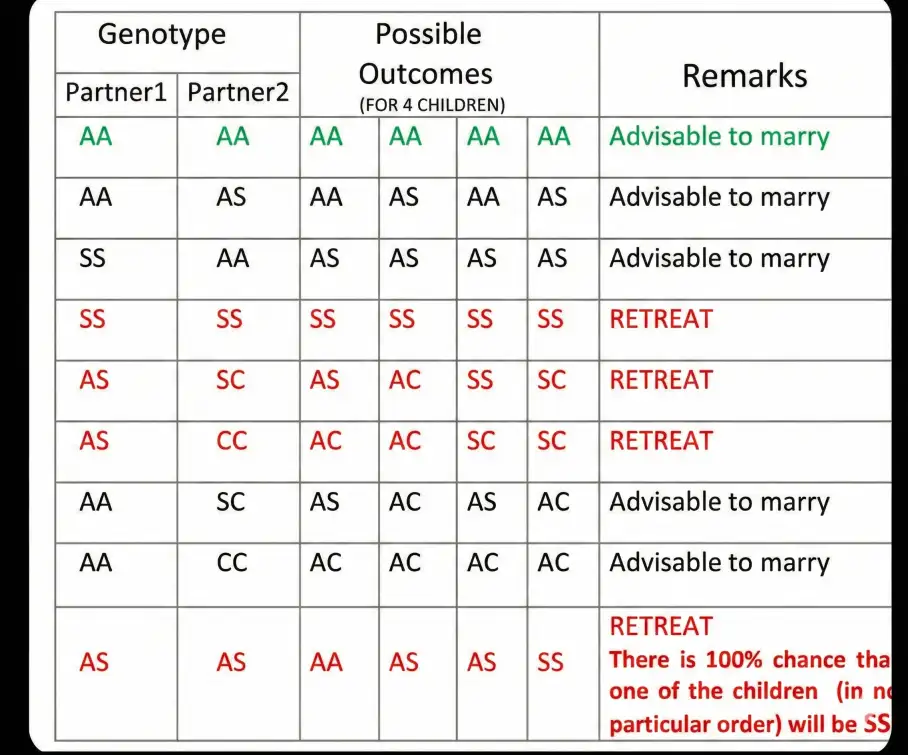
- AA + AA — All children will be AA. Completely safe.
- AA + AS — Children will be either AA or AS. No SS possible.
- AA + SS — All children will be AS. They will be carriers but healthy.
- AA + AC — Children will be AA or AC. Safe.
Risky Combinations
These pairings carry a real risk of producing a child with SS disease:
- AS + AS — Every pregnancy has a 1 in 4 chance of producing an SS child. This is the most common high-risk pairing.
- AS + SS — Every pregnancy has a 1 in 2 chance of producing an SS child.
- SS + SS — Every child will have SS disease. 100% risk.
- AS + AC — Risk of SC disease in children.
Two AS parents have four children. Statistically, one will have SS disease, two will be AS carriers like their parents, and one will be completely normal AA. But genetics does not follow a schedule — all four could be SS, or none of them. Every pregnancy is a fresh roll of the dice with the same odds.
What Life Looks Like with SS Disease
This is not a mild condition. Children born with SS disease face a lifetime of serious health challenges from infancy. Understanding what this means in real terms is important before making decisions about who you marry.
Painful Crises
The most recognisable symptom. When sickled cells block blood vessels, the result is severe, sudden pain — often in the chest, back, hands and feet. These crises can last hours or days. They require hospitalisation, strong painkillers, and often oxygen. They happen without warning and can be triggered by cold, dehydration, stress, or illness.
Anaemia
Sickled cells break down in 10 to 20 days. Normal red blood cells last 120 days. The body cannot replace them fast enough. This causes chronic anaemia — persistent tiredness, weakness, pale eyes, and shortness of breath that never fully goes away.
Organ Damage
Over years, the constant blocking of blood vessels damages organs silently. The spleen is often the first to fail — this leaves children vulnerable to serious infections that can kill quickly. The kidneys, eyes, heart, and lungs are also damaged over time.
Stroke
Sickled cells can block blood vessels in the brain. 1 in 10 children with SS disease will have a stroke before the age of 20. Silent strokes — which cause no obvious symptoms but damage the brain — are even more common.
A child in Accra is admitted to hospital for the sixth time this year. He is nine years old. His parents both have AS. They did not test before they married because no one told them to. The child spends weeks each year in hospital, misses school constantly, and lives in fear of the next crisis. His parents love him deeply and would give anything to undo what they did not know.
How Do You Know Your Genotype?
The Test is Simple
A genotype test is a basic blood test called hemoglobin electrophoresis. A small amount of blood is taken, usually from your arm. The lab analyses which type of hemoglobin you carry and gives you a result — AA, AS, SS, AC, or SC.
- Where: Any hospital, clinic, or diagnostic laboratory
- Cost: Usually between GHS 50 and GHS 150 in Ghana
- Time: Results in 24 to 72 hours
- Accuracy: Over 99% when done properly
That is all it takes. One blood test, one day, and you have information that protects your children for generations.
Common Things People Say — and the Truth
"AS people are healthy so it does not matter"
AS people are healthy — that is true. But when two AS people have children together, their health has nothing to do with what their children inherit. A healthy AS mother and a healthy AS father can produce a child with full SS disease. Your health does not protect your children from your genes.
"We will just stop if the first child is sick"
Each pregnancy carries the exact same risk as the one before it. The first child could be AA. The second could be SS. The third could be AA again. There is no pattern and no way to predict which pregnancy will produce which outcome. Every child is a new gamble with the same odds.
"We have prayed about it and believe God will protect us"
Faith is personal and deeply important. But genetics operates independently of belief. Many devout, faithful couples have had children with SS disease. Seeking a genotype test is not a lack of faith — it is using the knowledge and tools God has given us to make wise decisions.
"Modern medicine can treat it now"
Treatment has improved. Hydroxyurea, blood transfusions, and bone marrow transplants exist. But these are not cures for most people in Ghana and across Africa. They are expensive, not always accessible, and they do not eliminate pain or prevent all complications. Prevention remains far better than management.
What To Do Right Now
If You Are Not Yet in a Relationship
Get tested now so you know your genotype before emotions are involved. This is the easiest time to make clear-headed decisions. Tell your family and encourage them to know their genotypes too.
If You Are Dating Someone
Have the conversation early — before the relationship deepens to the point where ending it feels impossible. Present it as responsible planning, not rejection. If you are both AS, you are not obligated to end the relationship, but you owe it to your future children to understand the risk fully and make a conscious decision together.
If You Are Already Married with an Incompatible Genotype
You still have options. Pre-implantation Genetic Diagnosis (PGD) during IVF allows doctors to test embryos and implant only those without SS. Prenatal testing during pregnancy can identify whether a child has been affected. Adoption is also a meaningful path. Speak to a genetic counsellor who can walk you through all available options without judgement.
If You Are Already Pregnant
Chorionic villus sampling (CVS) at 10 to 13 weeks of pregnancy, or amniocentesis at 15 to 20 weeks, can tell you whether your baby has SS disease. Knowing early gives you time to prepare medically, emotionally, and practically — whatever you decide to do.
Knowing your genotype is one of the most loving things you can do before starting a family. The conversation is uncomfortable for one day. The consequences of not having it can last a lifetime. Test early, talk openly, and protect the children who cannot yet protect themselves.