You're sitting in class, watching your friend score 95 on the exam while you got a 72. Your heart sinks. You tell yourself: "I'm not smart enough. I'll never make it." Your parents look disappointed. Your teachers suggest you need to work harder. So you stay up until 3 AM, drinking cold coffee, telling yourself that if you just push harder, sacrifice more, and exhaust yourself completely, then maybe, just maybe, you'll be worthy of success. This article isn't going to tell you to give up on your dreams, or will it tell you to drop out of school. It's only going to present you with the facts you need to know so you can make better choices.
If No One Wants To Tell You, I Will
I'm Not Worth It
When you hear the word "pressure," what comes into mind first? Peer pressure right? Sure it is! But there is another kind of pressure that people do not talk about enough: academic pressure.
Many students are struggling with this. They are often forced to study subjects they do not actually like. This makes them feel stressed and unhappy. Even when they work hard and stay up late to study, they may not get the grades they want. This can make them feel like they are not good enough, but that is not true.
Here is something important to remember: Your grades do not decide your future. Many successful people were not top students in school. Some were just average, and some even dropped out, but they still built great lives. Do not let your school grades tell you who you are. You have your own talents, and you can prove your worth in many ways.
If you decide to change your path, it does not mean you are giving up. It means you are finding the right direction for your life. Success is about more than just what you learn in a textbook.
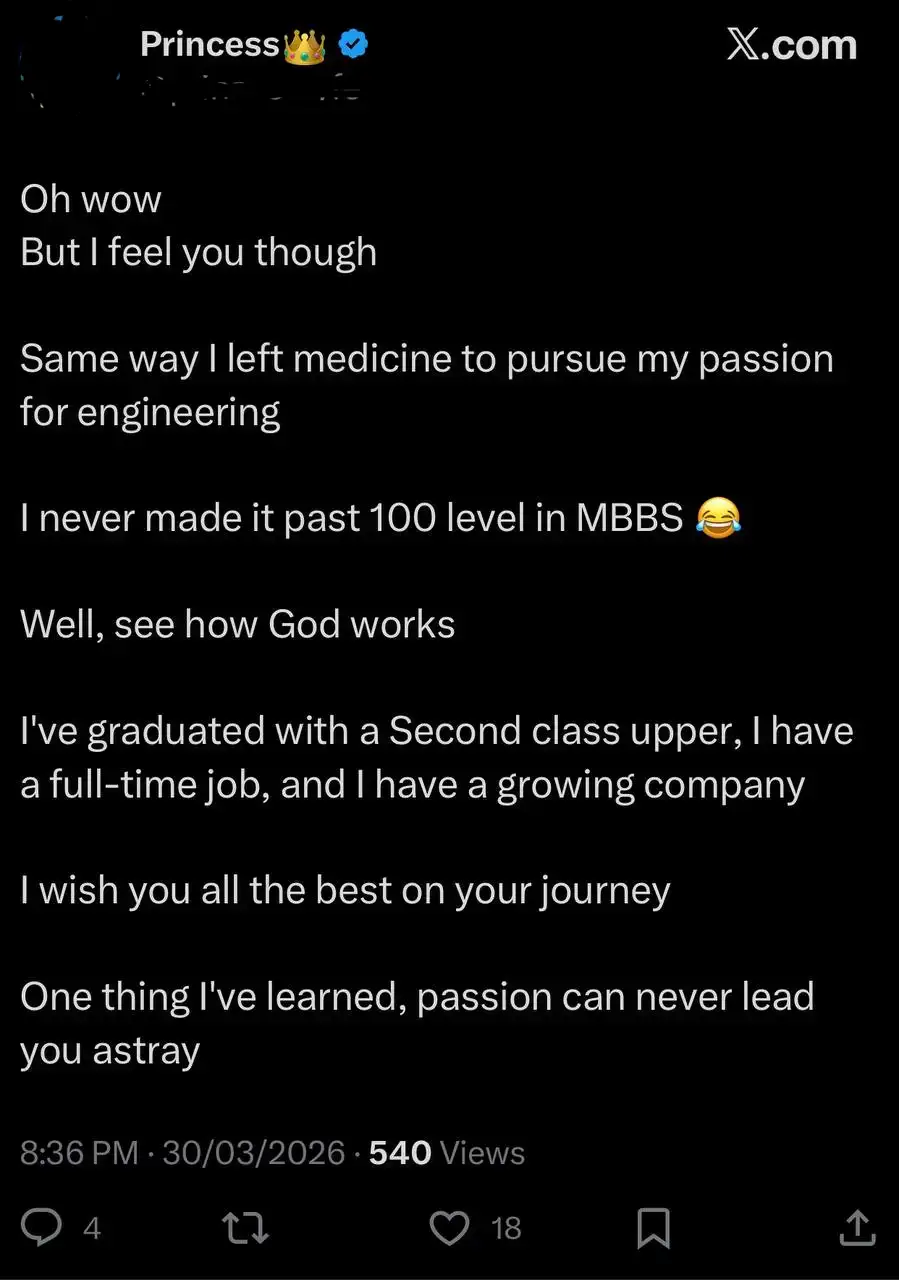
Kwame grew up in a small town. While other children played with toys, he was busy dismantling broken radios and fixing his father’s old alarm clocks. His dream was simple: to be an engineer. He wanted to build things, to solve problems, and to bring innovation to his community.
But at the dinner table, the conversation was always different. "We have teachers, farmers, and traders," his father would say, pointing a stern finger, "but we do not have a doctor. You will be the one to change that. You will be a doctor."
Kwame tried to explain his passion for building, but his voice was small against his parents' expectations. Feeling powerless, he enrolled in a medical program to please them.
The lecture halls were filled with dense textbooks and complex terminology that never sparked his interest. He spent his nights staring at anatomy charts, his mind wandering to circuits and blueprints. Without a spark of passion, the work felt like dragging a heavy stone uphill. He fell behind, his grades slipped, and ultimately, he could not graduate.
He returned home in shame, feeling as though he had failed everyone. But deep down, he knew he hadn't failed; he had just been on the wrong path.
He didn't stay down. Kwame took a grueling job at a local construction site, hauling cement and working long hours under the sun. He saved every penny he earned, living frugally and hiding his ambition in a small savings box under his bed.
After two years of hard work, he had enough. He walked into an engineering program, and for the first time in his life, he felt alive. Classes that were difficult were no longer a burden, but a puzzle he was eager to solve. He didn't just graduate; he excelled.
Today, Kwame runs his own engineering firm. He designs bridges and builds homes, turning his childhood dream into a reality that changes lives. His parents, now retired, live comfortably in a home he built for them. He never brought a medical degree to the family, but he brought something far more valuable: a son who found his purpose and, in turn, took care of everyone he loved.
It might be too late to give up on your program, but remember that you shouldn't let your grades dictate your future. Grades are just numbers; skills are what matter. Grades without skills are like a car part without an engine: it looks nice on the outside, but it won't take you anywhere.
Grades Are Not Destiny
Our educational system was designed in the 1800s to create factory workers, not to identify human potential. It measures one thing: your ability to memorize information and regurgitate it under time pressure. This is why you can't recall most of the lessons you took last semester: you were studying to pass, not to retain and apply knowledge.
Yet we've convinced ourselves and our students that this one metric defines their entire future. Get good grades or fail. Score in the top 10% or you're mediocre. Pass every exam or you're not worthy.
This is a lie, and it's damaging countless young minds.
The hard part? Knowing this intellectually is different from believing it emotionally when your parents are disappointed, when your peers are celebrating their acceptances, or when you're lying awake at night thinking you're not good enough.
In Ghana, our parents often expect nothing less than perfect scores. They seem less concerned with whether we actually understand our courses and more focused on the results. Frequently, we are forced into programs we never chose for ourselves, leaving us feeling academically broken and unfulfilled.
Real Stories: The Ones Schools Don't Celebrate
If This Doesn't Motivate You, Then Nothing Can
He spent his days roaming the halls of a famous university, but he was not actually a student. He would sneak into art classes because he loved how letters looked on a page. He lived on the floor of a friend's room, returned empty soda bottles to get money for food, and walked seven miles every Sunday night just to get one decent meal at a local temple.
The pressure to fit in was everywhere, but he felt a pull toward something else. Eventually, he made the hard choice to drop out of school. To his teachers and friends, it looked like a huge mistake. They thought he was throwing his future away. But he saw it differently. He saw a chance to finally focus on what he truly cared about.
He moved into a messy garage. He had no big plan, just a vision and a stubborn refusal to do things the way everyone else did. He faced many failures along the way. He was even fired from the very company he helped build. That was his lowest moment, but he later said it was actually the time he learned the most.
He never went back to the classroom to finish his degree. Instead, he kept chasing his passion. He built machines that changed how we all live. He turned complicated technology into simple, beautiful tools that now sit in everyone's pockets. He proved that you do not need a piece of paper from a university to be a genius.
From a hungry college dropout to a man who changed the world, he showed that your path is yours to create. He proved that your value is not defined by where you started, but by what you build with your own two hands.
The world knows him as the man who started Apple: Steve Jobs - Yes, the Founder of Apple( The Gen Z's phone).
 Source: (www.unsplash.com)
Other People Who Weren't Top Students (But Became Extraordinary)
Oprah Winfrey: Grew up in poverty, wasn't the top student in her class, faced racism and discrimination in school. Today, she's a billionaire, media mogul, and one of the most influential women in the world. No one cares about her high school GPA.
Richard Branson: Dyslexic, struggled academically, hated school. He's now a billionaire entrepreneur who built Virgin Industries into a global powerhouse. His success came from his ability to connect with people, take risks, and be resilient, not from his exam scores.
Walt Disney: Was told he had "no artistic talent" by his high school art teacher. He dropped out of high school to pursue animation. Rejected multiple times, nearly bankrupt several times. Still, he persisted and created an empire that changed entertainment forever.
J.K. Rowling: Struggled as a student, failed her university exams initially, and was rejected by 12 publishers before Harry Potter was accepted. She's now one of the wealthiest authors in the world. Her rejection letters are more famous than most people's success stories.
Muhammad Ali: Never finished high school but became arguably the greatest boxer and cultural icon of the 20th century. He was smart, charismatic, and unafraid to stand up for what he believed in.
Serena Williams: Didn't follow the traditional school path. Her father taught her tennis instead of sending her to traditional sports academies. She became the greatest tennis player of all time. Imagine if she'd been forced to prioritize academics over her passion.
The pattern here isn't luck. It's something deeper.
What These People Had That Exams Don't Measure
The Real Predictors of Success
If grades don't predict success, what does? Research in psychology, business, and personal development points to a few key qualities that schools completely ignore.
Resilience and the Ability to Bounce Back: Every successful person has failed more than once. Steve Jobs was fired from Apple, the company he founded. Oprah was fired from her first job. J.K. Rowling was rejected 12 times. These people didn't give up after one bad grade or one failure. They learned, adapted, and tried again.
Curiosity Over Compliance: Top students often excel because they follow the rules and do exactly what they're told. But the real world doesn't work that way. Innovation comes from people who ask "Why?" and "What if?" instead of just accepting "This is how we do things." Someone with average grades but burning curiosity will outpace the perfect student eventually.
Emotional Intelligence and People Skills: You can't Google your way to building relationships, leading teams, or understanding what people actually need. These skills are learned through real-world interaction, not textbooks. Many high-scoring students are brilliant but terrible at working with others. The average student who's good with people often goes further.
Persistence and Grit: Success isn't about being the smartest. It's about being willing to fail 100 times and try again. Malcolm Gladwell's "10,000-hour rule" shows that mastery comes from sustained effort over time, not innate talent or good grades. Anyone can develop this, but it takes choosing to show up even when you're not the "best."
Self-Awareness: Knowing your strengths, accepting your limitations, and being honest about what you're actually good at is rare. Many top students live in a bubble of false confidence until they hit the real world. Self-aware people, even if they're average students, know what to leverage and when to ask for help.
The Courage to Be Different: Successful people often take unconventional paths. They don't care if their path doesn't match the "approved" route. This isn't about being reckless, it's about having the confidence to forge your own way. Schools punish this. Life rewards it.
School measures none of these things.
The Cost of Chasing Perfect Grades
What You Lose When You Obsess Over Marks
Let's be honest about what happens when you make grades your primary goal.
Mental Health Deterioration: Anxiety, depression, and burnout are epidemic among high-achieving students. You sacrifice sleep, friendships, hobbies, and peace of mind for a number that doesn't actually predict your happiness or success. When your friends ask you out, you decline because you think having fun isn't worth it. This is how you turn into a robot, you can't even interact properly with your peers.
Lack of Real Skills: While you're cramming for exams, you're not learning public speaking, negotiation, problem-solving, creative thinking, or any skill that actually matters in the real world.
Lost Passion and Curiosity: You stop asking questions that interest you and only learn what's on the test. You stop pursuing hobbies and passions because they don't boost your GPA. You become a grade-producing machine, not a human being.
Fragile Self-Worth: When your entire identity is built on being "the smart one" or "the top student," what happens when you fail? Your entire sense of self crumbles. Real confidence comes from knowing who you are beyond any achievement.
Delayed Success: Many top students spend years climbing the "right" ladder only to realize it's leaning against the wrong wall. Meanwhile, the "average" student who actually found their passion 5 years earlier is already building something meaningful.
The irony? Most successful people will tell you that their academic performance had almost nothing to do with where they are today.
Finding Your Real Strength: A Path Forward
How to Discover What You're Actually Good At
If grades aren't the measure, what should you be paying attention to? Here's a practical framework for finding your real direction.
Step 1: Identify Your Natural Curiosities
What do you read about voluntarily? What podcasts do you listen to? What do you spend time on when no one's forcing you? What questions do you google at 2 AM out of pure interest?
These aren't trivial. They're pointing toward your real interests. Steve Jobs took a calligraphy class because he was curious, not because it was on a curriculum. That curiosity later became integral to Apple's design philosophy.
Step 2: Notice What Comes Easy to You (Not What You Get Grades In)
What activities make you lose track of time? What do people ask you for help with? What can you do for hours without getting tired?
These are clues to your strengths. You don't need a 90 in "Communication" to be someone people naturally talk to. You don't need top marks in "Leadership" to be someone others follow.
Step 3: Find Your People
Stop surrounding yourself only with people who validate the "top student" narrative. Find communities of people doing things you find interesting. Join clubs, online communities, mentorship groups, or circles where people care about growth, not grades.
You'll be shocked at how many successful people were "average students" in their specific field. You need to see yourself reflected in people who made it a different way.
Step 4: Take Calculated Risks
Try things that aren't on your resume. Start a project. Write something. Create content. Build something. Help someone solve a problem.
The goal isn't perfection, it's evidence that you can create, persist, and deliver. One real project completed is worth more on your resume than a 4.0 GPA with no experience.
Step 5: Invest in Skills Schools Don't Teach
Learn communication, sales, psychology, negotiation, coding, writing, design, video production, or anything that interests you. These are skills the real world actually values.
Take free courses, watch tutorials, practice, and build. You don't need permission or a grade to become skilled. You just need curiosity and consistency.
Step 6: Reframe Your Failures
Every successful person has a list of failures longer than their successes. The difference is they see failures as data, not judgment.
Got a bad grade? What can you learn? Did you not understand the material? Did you run out of time? Did you not care about the subject? Each answer points to something real about yourself, not something wrong with you.
Step 7: Protect Your Mental Health First
If school is destroying your mental health, it's not worth it. Your peace of mind, sleep, relationships, and emotional wellbeing are more important than any grade.
Talk to someone if you're struggling. A counselor, therapist, trusted adult, or friend. You don't have to carry this alone, and you don't have to pretend everything is fine when it's not.
A Different Conversation About Success
What Success Actually Looks Like
Here's what no teacher told me until I was already struggling: success in life is not linear. It's not measured in GPA. It's not achieved by the time you're 22 with a degree from the "right" university.
Success is:
- Doing work that matters to you
- Having people in your life who care about you
- Being able to solve problems and create things
- Having the resilience to fail and try again
- Knowing yourself well enough to make decisions aligned with your values
- Contributing something to the world, no matter how small
Some of the most successful and fulfilled people I know were mediocre students. They found their passion later. They took longer paths. They failed more times. And because of that, they have stories, skills, and depth that top students often lack.
Your grades are feedback on one specific thing: how well you perform academic tasks. That's all. They're not a verdict on your intelligence, your potential, or your worth as a human being.
To the Student Reading This Right Now
You Are Not Behind; You Are Not Failing
If you got a bad grade, it doesn't mean you're not smart. It means you either didn't understand the material, didn't have enough time, didn't care about the subject, or the testing format didn't suit you. None of those things define you.
If your parents are disappointed, if your peers seem to be doing better, if you feel like you're falling behind, listen to this: you're not failing. The system measuring you is failing you.
You have strengths that no exam will ever find. You have potential that no transcript will ever capture. You have a path to success that looks nothing like the one they've laid out for you, and that's not a problem. That's an opportunity.
The light inside you isn't dim because of a grade. It's waiting for you to stop chasing someone else's definition of success and start pursuing what actually makes you come alive.
You have time. You have potential. You have choices.
Don't waste your limited energy trying to be the best version of someone else's dream. Use it to become the only version of your own.
And that, no grade can measure.
🧠
"Your future isn't determined by tomorrow's exam. It's determined by what you do with the lessons you learn, the resilience you build, and the courage you muster to forge your own path."